Menopause explained: what changes and how to support yourself
Perimenopause vs menopause without the panic: why hot flushes, poor sleep and mood swings happen, what to do for bones and heart, protein and strength, and when to discuss HRT with a doctor.

Contents
Menopause is not a disease or a malfunction — it is a normal transition, when the ovaries stop producing estrogen and progesterone. Technically menopause is reached 12 consecutive months after your last period, at an average age of about 51. Perimenopause, the years of hormonal ups and downs leading up to that point, starts earlier (often at 45–47) and lasts around 4–8 years on average. Most symptoms — hot flushes, disrupted sleep, mood swings, brain fog — appear during perimenopause. The good news: almost all of it is manageable, and the three things with the strongest evidence are strength training, enough protein, and a conversation with your doctor about treatment options.
Perimenopause vs menopause: the difference
Confusing terminology makes it hard to understand what is happening. Let's untangle it.
Perimenopause is the transition. The ovaries still work, but erratically: estrogen does not decline smoothly, it swings — sometimes above normal, then sharply down. Cycles become irregular: shorter, then longer, periods heavier, then skipping two or three months. It is these swings, rather than low estrogen itself, that cause the most unpleasant symptoms. The average length is about 4 years, but for some women it stretches to 8–10.
Menopause is one specific date you can only name in hindsight: 12 consecutive months without a period. The global average age is 51; before 45 it is called early menopause, and before 40 premature ovarian insufficiency (which deserves separate medical attention).
Postmenopause is everything after. Hormones stabilise at a low level, acute symptoms gradually ease for most women, but the long-term effects on bones and blood vessels move to the foreground.
Per the NICE guideline, at a typical age the diagnosis is clinical — based on symptoms and cycle pattern, without mandatory hormone tests. An FSH test is mainly useful when early menopause is suspected or in women under 45, because during perimenopause hormones swing and a single measurement tells you little.
Symptoms: where they come from
There are many symptoms and they can seem unrelated, but most trace back to fluctuating and falling estrogen, which has receptors in almost every tissue — from blood vessels to the brain and bones.
| Symptom | What drives it | How common |
|---|---|---|
| Hot flushes, night sweats | Disrupted temperature control in the hypothalamus as estrogen drops | Up to 75–80% of women |
| Sleep problems | Night flushes, a direct effect on sleep, and anxiety | 40–60% |
| Mood swings, anxiety | Hormone fluctuations plus poor sleep; higher risk if prone to depression | Common |
| Brain fog, forgetfulness | Usually temporary, linked to poor sleep and hormone swings | Common, reversible |
| Vaginal dryness, discomfort | Genitourinary syndrome — tissue thinning from estrogen deficiency | Up to 50%, more common over time |
| Joint aches, lower libido | Multifactorial, with estrogen deficiency contributing | Variable |
A word on hot flushes (vasomotor symptoms). This is the most recognisable sign: a sudden wave of heat, usually in the upper body, flushing, sweating, sometimes a racing heart. An important and little-known fact: large cohort studies show they last around 7–10 years on average, and for some women longer. This is not "a couple of hard months" — it can be years, and that is normal, and it is treatable.
Sleep suffers for several reasons at once: night sweats wake you, anxiety keeps you from falling asleep, and estrogen and progesterone themselves affect sleep architecture. Breaking the loop of "bad sleep → worse mood and flushes → even worse sleep" is one of the main practical goals.
Bones: the quiet but important problem
Estrogen restrains the breakdown of bone tissue. When its level falls, bone loss accelerates — most sharply in the first years after menopause, when a woman can lose up to 2% of bone density per year. The result is a rising risk of osteoporosis and fractures later in life. It happens without symptoms: bone thins silently, and the first sign is often a fracture.
What actually works for bones:
- Strength and impact loading. Mechanical load is the main signal for bone to build itself. Squats, lunges, weight-bearing work, plus jumping and brisk walking (where there are no contraindications) support density better than any supplement.
- Enough protein. Bone is not just calcium — it has a protein scaffold. A protein shortfall harms both bones and muscle.
- Calcium mainly from food (dairy, tofu, greens, fish with bones) plus vitamin D — as indicated, ideally after checking your level. Megadoses are unnecessary and not safer.
- Less smoking and excess alcohol — both speed up bone loss.
Читайте также: Sarcopenia: how to keep your muscle as you age
Muscle and nutrition: protein and strength are not optional
Alongside bone, muscle loss (sarcopenia) speeds up after menopause and body composition shifts: fat moves toward the abdomen. This is not only about appearance — visceral fat worsens insulin sensitivity and adds to cardiac risk.
Two levers you control:
Protein. A target for most adults is 1.2–1.6 g per kg of body weight per day, spread across meals (25–35 g per sitting stimulates muscle protein synthesis better than getting all your protein at dinner). With age, muscle responds less well to protein, so the lower end of the range is already on the low side.
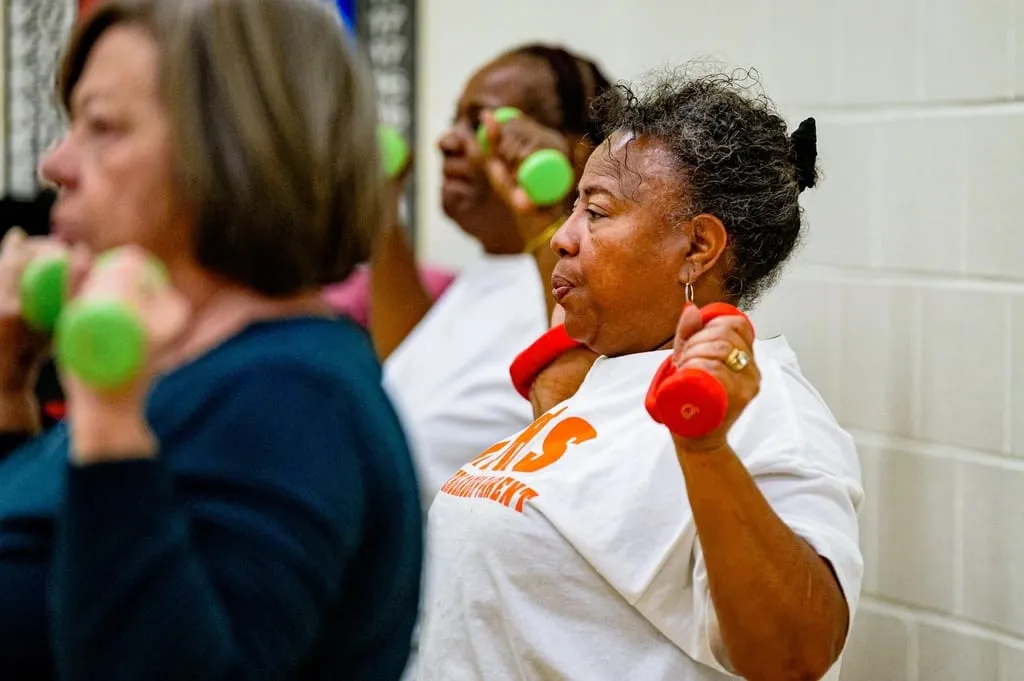
Strength training. 2–3 times a week for the major muscle groups, with a gradual increase in load. This is the only way not merely to slow but to reverse muscle loss — and at the same time the best friend of your bones, glucose metabolism and mood. It is never too late or "too much" to start: even in older adults, resistance training builds strength and mass.
Читайте также: Strength training for beginners: where to start
Cardio is not off the table — it works for the heart (see below) and helps with sleep and mood. The ideal setup combines strength and aerobic work.
Heart and blood vessels: why risk rises after menopause
Before menopause, women have lower cardiovascular risk than men of the same age — estrogen partly protects the vessels. After menopause that head start disappears: per the American Heart Association scientific statement, the menopause transition is a period of adverse shifts. LDL ("bad") and total cholesterol tend to rise, blood pressure goes up, insulin sensitivity worsens, and fat redistributes toward the centre of the body.
The practical takeaway: perimenopause is a good time to get a check-up, know your numbers (blood pressure, lipid panel, glucose/HbA1c) and act on them. The core levers are the same ones that protect bones and brain:
| Factor | Goal | Why it matters after menopause |
|---|---|---|
| Blood pressure | Know your numbers, keep in range | Tends to rise during the transition |
| Lipids (LDL) | Check, discuss with your doctor | LDL and total cholesterol usually rise |
| Movement | Strength + cardio | Cuts risk on several fronts at once |
| Smoking | Quit | One of the strongest modifiable risk factors |
| Weight and waist | Manage visceral fat | Central fat shift worsens metabolism |
HRT (hormone therapy): brief and to the point
Menopausal hormone therapy (HRT, also called MHT) is the most effective way to relieve hot flushes and night sweats and to help with the sleep and mood problems tied to them; it also protects bone. Much of the fear around it dates to the early 2000s, after the first Women's Health Initiative (WHI) publications were widely misinterpreted. Later, more detailed analysis of the same data softened the picture.
What matters to know (and to discuss with a doctor rather than decide alone):
- Timing window. For healthy women starting therapy before age 60 or within roughly 10 years of menopause, the benefits usually outweigh the risks when symptoms are bothersome. The later the start, the more the balance shifts.
- Route matters. Transdermal estrogen (patch, gel) carries a lower clotting risk than tablets. Women with a uterus add a progestogen to protect the endometrium.
- Long-term mortality. Across 18 years of WHI follow-up, hormone therapy did not raise all-cause mortality — an important counterpoint to old fears.
- It is individual. A history of clots, some cancers, liver disease and other conditions can make HRT unsuitable. So it is always a personal decision.
For women for whom hormones are unsuitable or unwanted, non-hormonal prescription options for hot flushes exist — also discussed with a doctor. And for vaginal dryness and discomfort, low-dose local estrogen is often enough, with a safety profile different from systemic therapy.
What does NOT work: honest talk about supplements
On the wave of fear about hormones, a whole industry of "natural" menopause remedies has grown. The problem is that their evidence base is weak.
- Phytoestrogens (soy, isoflavones, red clover) — in good-quality trials the effect on hot flushes is either absent or indistinguishable from placebo.
- Black cohosh — data are inconsistent, no convincing benefit has been shown, and there are liver-safety questions.
- Custom-compounded "bioidentical" hormones from pharmacies, mixed individually, are not tested for quality and dose and are not recommended by professional societies. They are not the same as regulated HRT.
- A host of other "hormone-balancing" supplements are marketing without evidence.
The placebo effect in hot-flush trials is large (often 30–50% improvement), so personal "it helped me" reports are unreliable. Money and attention are better invested in what actually works.
Читайте также: Iron for women: deficiency, ferritin and how to top up
What to do: a practical plan
- Drop the drama. This is a transition, not a breakdown. Symptoms are real but manageable, and there is a working solution for almost every one.
- Fix your sleep. A cool bedroom, light clothing, a steady schedule, careful with alcohol and caffeine later in the day. Sleep is a lever that improves both mood and hot-flush tolerance.
- Start strength training 2–3 times a week. It is the most evidence-backed investment in bones, muscle, metabolism and mood. Add cardio for the heart.
- Get your protein up to 1.2–1.6 g/kg, spread across meals. Calcium mainly from food, vitamin D as indicated.
- Get a check-up. Blood pressure, lipids, glucose/HbA1c. Knowing your numbers now means managing the cardiac risk that is rising.
- Discuss treatment options with your doctor. If hot flushes, sleep or mood are disrupting your life, that is not something to heroically endure. Ask about HRT and non-hormonal options and decide together.
- Don't spend on "menopause" supplements. There is no evidence; direct those resources to the points above.
Menopause is half of adult life still ahead, not the finish line. Investment in strength, sleep, heart health and good medical support pays off most precisely during these years.
FAQ
What is the difference between perimenopause and menopause?+
Perimenopause is the transition years of fluctuating hormones and irregular cycles, lasting about 4–8 years on average. Menopause is a single point: 12 consecutive months without a period, at an average age of about 51.
How long do hot flushes last?+
For most women vasomotor symptoms persist for around 7–10 years on average, not just a year or two as many assume. For some they are mild; for others they seriously disrupt sleep and daily function.
Is HRT dangerous?+
For healthy women who start treatment before age 60 or within 10 years of menopause, the benefits usually outweigh the risks when symptoms are bothersome. The decision is always individual and made with a doctor based on your history.
Do supplements help with hot flushes?+
There is no convincing evidence that phytoestrogens, black cohosh or most supplements work — in trials they perform at the level of placebo. The money is better spent on sleep, strength training and discussing real options with a doctor.
References
- 1.NICE. Menopause: diagnosis and management (NG23), 2015, updated 2019
- 2.The Menopause Society (NAMS). The 2022 Hormone Therapy Position Statement
- 3.The Menopause Society. The 2023 Nonhormone Therapy Position Statement
- 4.Manson JE, et al. Menopausal Hormone Therapy and Long-term All-Cause and Cause-Specific Mortality (WHI). JAMA, 2017
- 5.El Khoudary SR, et al. Menopause Transition and Cardiovascular Disease Risk. AHA Scientific Statement. Circulation, 2020
Read next
Osteoporosis: The Prevention That Starts in Your Thirties
How bone tissue works, why peak bone mass is set before 30, what menopause changes, who needs a DXA scan, and which measures genuinely reduce fracture risk.
Calcium: How Much You Need and How to Get It Without Dairy
Calcium requirements by age, the best dairy and plant sources, why vitamin D and protein matter, and who actually needs a supplement rather than taking one just in case.

Vitamin D: Doses, Blood Levels and Who Actually Needs It
How to read a 25(OH)D result, which doses work for prevention and for correcting deficiency, who should be tested, and where the overdose risk begins.
Contraception: Methods, Effectiveness and How to Choose
A guide to birth control by real-world effectiveness: hormonal and non-hormonal, IUDs and implants, condoms and emergency contraception — with typical, not perfect, use rates.
Endometriosis: Why It Hurts, How It Is Diagnosed and What Helps
Endometriosis is a common cause of severe menstrual and pelvic pain that is mistaken for normal for years. Its symptoms, diagnosis, treatment and when to see a doctor.

PCOS: Signs, Diagnosis and What Actually Helps
How polycystic ovary syndrome is diagnosed, why it has nothing to do with cysts, where insulin resistance fits in, and which treatments have real evidence behind them.